
Your cart is currently empty!
Category: books
-
Q&A with Tonight's Reader David Moscovich

David Moscovich David Moscovich, author of You Are Making Very Important Bathtime, is no stranger to cross-country jaunts. The New York resident will be journeying here to Quimby’s for a reading with fellow writer Eckard Gerdes tonight. Nicki Yowell, Quimby’s Outreach and Communications Coordinator, caught up with David to chat about clumsy Japanese translations, the perils of teaching and the many iterations of his performances.
Quimby’s: You’ve resided in quite a few places during your life: Portland, New York, Boston, Japan. Would you say your personal well-rounded sense of place factors strongly into your work?
David Moscovich: My sense of place is probably more lopsided because of my personal geography — but being a Nebraska boy at root keeps me humble enough. Growing up in my own personal iron curtain as a Romanian-American in Nebraska gave me a sense of aloneness that didn’t disappear until I visited the old country as an adult. How does that translate into my work? I think it keeps experiences relative, and my attempt with Bathtime is to fuel misunderstandings between characters with even greater misunderstandings, to pose the assumptions of American and Japanese cultures in comical juxtaposition with each other. I try to expose the narrator’s biases and preconceptions in Bathtime by allowing him to gaff and to faux pas his way through most situations. In a sense, I tried to create a character who has committed a spiritual crime, a kind of culture-cide, but does not have the conscience to realize it. It torments him but not in the way a Raskolnikov is tormented.
Q: Flash fiction is a literary medium that seems to fit well with our times. Short, punchy, quick to get your attention. What draws you to shorter narratives? Are they more approachable in our temporally fractured culture?
DM: The way the story tells the story has to be more immediate in short fiction. I want to say more with less, and I also revise obsessively. It’s not that I am always drawn to the short form, but often I’ve cut back more than fifty percent of the words. You Are Make Very Important Bathtime is a complete rewrite of a much longer novel that I threw out to rework the voice. I wanted it to be about the voice. I also think of short fiction like punk rock. Put together fifty fast-paced songs and there is a concentrated performance that tells a longer story.
Q: The title of your latest book, You Are Make Very Important Bathtime, reminds me of a dubiously named website, Engrish.com. Translating Japanese to English can be a tenuous, problematic proposition, indeed. How does the central problem of language factor into the story?
DM: You Are Make Very Important Bathtime plays with the notion of weird, broken, unconventional and/or unaccepted grammar as a cause for celebration. Usually without thinking we accept grammar as a set of patterns that are “correct” in any given language without acknowledging that “correct” grammar might be viewed as merely another aesthetic.
Throughout the work is the comma splice, which came from a desire to intentionally circumvent the rules of punctuation and give the sense of reading each story in one long breath. The Japanese language also allows for females to refer to themselves by name. A character, Kimiko, says to the narrator: Kimiko loves okonomiyaki. These types of peculiarities fascinate me, like the fact that it’s possible to hold an entire conversation in Japanese without the use of a subject.
Language teachers might berate a student for collocational fumbles or syntactical mishaps but language itself loves errors and to me it sounds like poetry. Japanese is a very flexible tongue. Switch around verbs and nouns and leave out subjects, still we are understood. Languages are transforming, living beings, the long tentacles of cultures they are attached to. My attempt is to embrace all of it, to fully love the flexible grammar out there.
In one of the stories, a certain beer menu reads, “Please Choose the Drunk.” It’s incredible how much impact a single letter can have. And that is part of the book, this enormous potential that lies within the playing and shifting of letters.
Q: How has teaching shaped your point of view of writing? Do you ever picture your students as your audience or are you their audience?
DM: The goal for me is to marry writing and teaching by channelling them in a state of urgent transmission. Writing happens from a necessity of expression, as Rilke would have it. The delineation between teaching and the performance behind the writing disappears. That is the ideal — to share completely and selflessly what has worked for me as a writer, and equally so, what has not worked.
Q: Much of your work has a performance or performed component. You’ve done radio broadcasts and musical collaborations in addition to your live readings. Do you consider these performances to be separate and complete or a necessary companion to the written work you make?
DM: I like to think they compliment each other but ideally each stand alone. They are also different mediums. If a person prefers reading without the social aspect necessary for performance they can read instead. What I’m trying to do with the live performance is to offer something from my work that a reader cannot get just holding the book. But even within reading a written story to oneself there are so many possibilities. Any book could be read in a non-linear fashion as well as the traditional way from the first story to the last. You Are Make Very Important Bathtime was designed as a book to be read in any and every order whatsoever. The sequence offered in the book as published could be thought of as a “serving suggestion.” The reader sets the table.
-
Maureen Foley Reads, with Mark R. Brand and Mason Johnson 9/5


Join the Chicago Center for Literature and Photography as Quimby’s showcases three of MMMarvelous writers at Quimby’s on Thursday, September 5th. Local authors Mark R. Brand and Mason Johnson will be reading from their new books, the respective Long Live Us and Sad Robot Stories; and headlining the evening will be California author Maureen Foley, in town to promote her female relationship dramedy Women Float. All three authors will be available for signing books afterwards. We hope you will be able to join us for this MMMost enjoyable evening!
Maureen Foley is a writer and artist who lives on an avocado ranch by the sea in Southern California with her daughter, stepson and husband, writer James Claffey. Her writing has appeared in Wired, Caesura, The New York Times, Santa Barbara Magazine, Skanky Possum and elsewhere. [maureenfoley.com]
Mason Johnson is a writer from Chicago who currently works full time writing and editing articles for CBS. Also, he pets all the cats. [themasonjohnson.com]
Mark R. Brand is the author of the novels Red Ivy Afternoon (2006), Life After Sleep (2011), and The Damnation of Memory (2011), as well as the editor of the 2009 anthology Thank You, Death Robot. He is a two-time Independent Publisher Book Award winner and is the creator and host of the video podcast series Breakfast With the Author. [vinniethevole.com]
For more info, visit cclapcenter.com or write cclapcenter(at)gmail(dot)com
-
Steve Miller Talks Detroit Rock City Book and Punk Rock Provocateur Tesco Vee Squawks Touch and Go
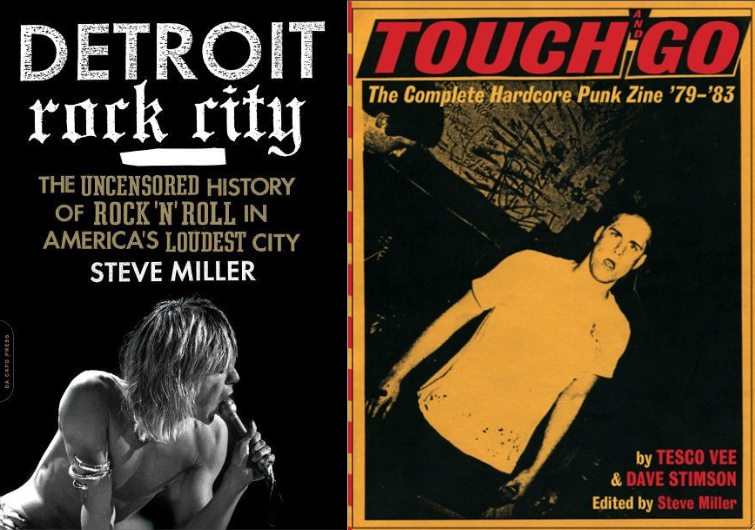
Michigan madmen Steve Miller and Tesco Vee, veterans of the unbridled musical sounds that made the Midwest famous, appear together July 26 to talk about Miller’s new oral history, Detroit Rock City: The Uncensored History of Five Decades of Rock ‘N Roll in America’s Loudest City (Da Capo). The two will also discuss the classic punk rock tome Touch and Go: The Complete Hardcore Punk Zine ’79-’83 (Bazillion Points), the 576-page monsterpiece written by TV and edited by Miller.
Steve Miller is a noted true crime author, award-winning investigative journalist, and former singer of hardcore punk legends the Fix. In Detroit Rock City, Miller spins a tale of rust belt rebellion culled from hundreds of hours spent interviewing a litany of rock titans, from Alice Cooper and Iggy Pop to Jack White and John Brannon. Miller does the walkin’ and lets the principals do the talkin’ as he creeps through 50 years of hard rockin’ magnificence from the “Mitten.”
Tesco Vee is the irascible, ageless, iconic punk rock impresario, renaissance man, and founder of Touch and Go. His band The Meatmen continue to amaze and astound. His rapier wit will be on full display Friday.
Detroit Rock City is …A sharply edited oral history that nails most of the major players and includes the inherent contradictions in each person’s account of how history went down, it offers up that singular Detroit attitude that somehow fuses an inferiority/superiority complex into something loud, aggressive, and delightfully unique. Not to be crude, but– holy crap. – Dave DiMartino, former editor, Creem magazine
“Creem may have taught me how to piss, but Touch and Go taught me how to shit. I owe my career to that magazine.”—John Brannon, Negative Approach
-
Fan Interference: The Best of Zisk Zine Release Event with Mike Faloon, Steve Reynolds and Jake Austen 7/19
Intending to cover baseball from a fan’s perspective, the first issue of Zisk was published in the summer of 1999 and is now published twice a season. Named for the former “South Side Hitman” Richie Zisk, the zine is for those who love the charm, history and quirks of America’s pastime. The publication is edited by New York-based writers Mike Faloon and Steve Reynolds and is touted as “the Baseball Magazine For People Who Hate Baseball Magazines.” FAN INTERFERENCE: A COLLECTION OF BASEBALL RANTS AND REFLECTIONS (Blue Cubicle Press, 2013) is an anthology of the best musings culled from over 15 years of Zisk. Edited by MIKE FALOON (Go Metric, Egghead.) and STEVE REYNOLDS (Trouser Press, Party Like It’s 1999) and featuring contributions from academics to punk rockers, comedians to fans with an ax to grind, FAN INTERFERENCE examines the intersection of baseball, lifestyle and music — all colored with bit of nostalgia, a great deal of humor and, often, a tongue planted firmly in cheek.
In addition to Faloon and Reynolds, contributors to the anthology include JAKE AUSTEN (author, TV-A-Go-Go: Rock Music on Television from American Bandstand to American Idol), SEAN CARSWELL (college professor, co-founder of the independent music magazine Razorcake and the independent book publisher Gorsky Press), KEVIN CHANEL (Punk Rock Confidential), BRIAN COGAN (The Encyclopedia of Punk), DR. NANCY GOLDEN (writer; wildlife toxicologist), JOHN SHIFFERT (author, Base Ball in Philadelphia), TODD TAYLOR (founder and executive director of Razorcake/Gorsky Press Inc.), CHARLIE VASCELLARO (journalist, Washington Post, Chicago Sun Times, Los Angeles Times), ARI VOUKYDIS (comedian/writer, BuzzFeed, GQ, Grantland, etc) and REV NORB (musician; inventor of Sick Teen magazine, former writer for Maximum Rocknroll).
FAN INTERFERENCE: A COLLECTION OF BASEBALL RANTS AND REFLECTIONS (Blue Cubicle Press, 2013)
Anthology – Paperback
238 pages Print – $22.95
ISBN: 978-1-938583-04-9
“…For those who love baseball for its charm, history and eccentricities and not merely as something to play a fantasy league around. It’s for the true fans who populate the upper deck, not the party animals in the bleachers.” – Chicago Tribune
“Baseball is the most important thing in the world. It’s also completely meaningless in the grand scheme of life. These guys recognize that those two philosophies can co-exist in the human brain, which makes their writing a truly electric, and all too rare, jolt to the synapses.” – Variety
Fri, July 19th, 7pm
For more info:
-
Pete Jordan Reads From In the City of Bikes: The Story of the Amsterdam Cyclist 5/5

Pete Jordan, author of Dishwasher, tells the story of his love affair with Amsterdam, the city of bikes, all the while unfolding an unknown history of the city’s cycling, from the craze of the 1890s, through the Nazi occupation, to the bike-centric culture adored by the world today.
Part personal memoir, part history of cycling, part fascinating street-level tour of Amsterdam, IN THE CITY OF BIKES: The Story of the Amsterdam Cyclist is the story of a man who loves bicycling in a city that is obsessed with bikes.
When Pete’s story begins, his goals for an upcoming semester abroad are clear: study how to make America’s cities more bicycle friendly, and then return home—simple and straightforward. Once he sets foot in Amsterdam, however, Pete falls immediately in love with the city that already lives life on two wheels—and suddenly, he can’t imagine living anywhere else.
But hardships loom in Pete’s adopted homeland. As Pete skips from one short-term apartment rental to the next, stability stays just out of reach and work is increasingly difficult to find. Meanwhile he stumbles upon unforeseen pleasures in his daily bike rides and begins his dig into the city’s cycling past. What he discovers there is no less an untold cultural history of Amsterdam.
From cycling’s beginning as an elitist pastime in the 1890s to the street-consuming craze of the 1920s, from the bicycle’s role in city-wide resistance to the Nazi occupation to the legendary (yet mythical) success of the White Bikes in the 1960s all the way up to the mysterious bike fishermen of today, in IN THE CITY OF BIKES Jordan illuminates the bicycle’s integral role in shaping both the psyche and city of Amsterdam.
“An excellent choice for bikers and those who appreciate how a city’s history can be changed by the simplest of passions.”
–Kirkus Reviews
“Part memoir, part history, the book gives readers looking to unlock the city’s secrets an opportunity to follow in the author’s tracks.”
–Publishers Weekly
Pete Jordan is the author of the memoir Dishwasher: One Man’s Quest to Wash Dishes in All Fifty States. Pete’s work has been featured on public radio’s “This American Life” and in The New York Times. He lives with his son in Amsterdam.
Sunday, May 5th, 3pm – Free Event
For more info, download In the City of Bikes Press Release from the publisher.
-
Ian Svenonius Reads From Supernatural Strategies for Making a Rock 'n' Roll Group 5/7
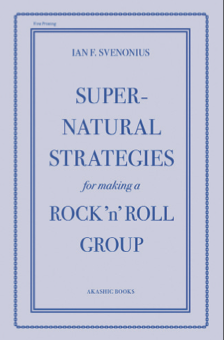 TRUE ROCK ’N’ ROLL SECRETS REVEALED! DC SINGER IAN F. SVENONIUS COMMUNES WITH DEAD MUSICIANS TO CREATE A HOW-TO GUIDE FOR MAKING A SUCCESSFUL ROCK ’N’ ROLL GROUP
Don’t miss rock icon Ian Svenonius reading from his provocative, extremely hilarious, and bizarrely erudite book entitled “Supernatural Strategies for Making a Rock ‘n’ Roll Group.” The book pretends to be a “how-to” guide for people wanting to start a rock band, but it is so much more — fusing a meticulously researched sociopolitical examination of the history of rock and roll music with Ian’s trademark humor and cutting wit, one of the best rock and roll satires ever written. The author, who is most well-known as the singer of The Nation of Ulysses and The Make-Up, two of the most popular bands to emerge from DC’s Dischord record label, is a charismatic showman and performer. He is also the author of the underground smash book of essays The Psychic Soviet.
“People now expect a nice ‘career’ from their music. This is misguided and, today, perhaps impossible. Suffering is necessary to maintain the integrity of the group as an object.” —Brian Jones, Rolling Stones, as told to Ian F. Svenonius from beyond the grave
“Rock ’n’ roll is an American art, brought about by the Industrial Revolution, the harnessing of electricity, and the miscegenation of various poor, exploited, and indentured cultures in the USA.” —Jimi Hendrix, as told to Ian F. Svenonius from beyond the grave
“Since [this] is a nation founded on the ideas of individualism, rebellion, evangelism, white supremacy, black slavery, expulsion of native peoples, expansionism, and commerce, these values all play a part in the formation of the USA’s primary and arguably greatest cultural export.” —Richard Berry, composer of “Louie, Louie, as told to Ian F. Svenonius from beyond the grave
Supernatural Strategies for Making a Rock ’n’ Roll Group addresses never-before-discovered revelations about that most beloved American cultural pastime; not only does this book help the aspiring inge?nue to start his or her own rock ’n’ roll group, it also confronts the strange and murky origins of the group itself and the reason for its ubiquity and cultural currency, still going strong since its initial, shocking, and cataclysmic appearance during the cold war.
BY TALKING TO DEAD ROCK ’N’ ROLL STARS such as Brian Jones, Jim Morrison, et al., for pointers, Svenonius—the front man of influential groups The Nation of Ulysses and The Make-Up, and currently the singer of Chain & the Gang—is able to furnish a more complete picture than the normal myopic critic/historian eggheads. Supernatural Strategies proposes the origins of the group to be not just blues music as is commonly supposed, but also the street gangs which terrorized the landscape of industrial-era America, and which were romanticized in media (e.g., Westside Story).
SUPERNATURAL STRATEGIES EXPLAINS THAT THE GROUPS’ use as a propaganda instrument against Socialist ideology was central to their proliferation during the postwar era, and suggests that the continued tolerance of the presence of groups might only be totemistic, as they have possibly outlived their usefulness to the elite.
THE BOOK OUTLINES THE SIGNIFICANCE of group names, live concerts, vans, sex, drugs, band photos, records, record labels, recording studios, and all the other bugaboos which serially feature in group life. It explains the future relevance of groups and the strategies that groups can use to successfully understand and embody their destinies, historic roles, and responsibilities. It is a must- read for anyone who is alive in the early portion of the new century.
SUPERNATURAL STRATEGIES is a combination of occult esoterica, how-to manual, socioeconomic textbook, fanzine, and revolutionary pamphlet, this book is bound to overtake Plato, McLuhan, Marx, and Hesse in dogs eared.
This book touches on such related topics as: How rock ‘n’ roll emerged from American gang culture; The role of the Soviet Union in modern popular culture; Why it’s crucial that members of rock ‘n’ roll groups communicate with each other in an indirect manner; Why music groups need strict codes of discipline; The historic underpinning of groupie culture, and the related issue of necrophilia; The influence of the Black Panthers on rock ‘n’ roll music; The significance of vans and other motorized vehicles to rock ‘n’ roll beyond the obvious transportation aspect; The diminishing meaning of the rock ‘n’ roll group in 2013 and beyond; What young musicians today can still learn from Buddy Holly, Richard Berry, and Brian Jones.
For more info:
Ian’s Soft Focus series, where he “tenderly interrogates” the likes of Thurston Moore (Sonic Youth), Chan Marshall (Cat Power), and Adam Horovitz (Beastie Boys), among others: vice.com/soft-focus.Check out these links for a small sampling of what some of the press is saying about the book so far:
Onion A/V Club
Los Angeles Times
American Songwriter
Mother JonesClick here to download the publisher’s press release:
SupernaturalStrategiesPress ReleasePress and publicity inquiries can be directed to Ibrahim Ahmad: ibrahim(at)akashicbooks(dot)com.
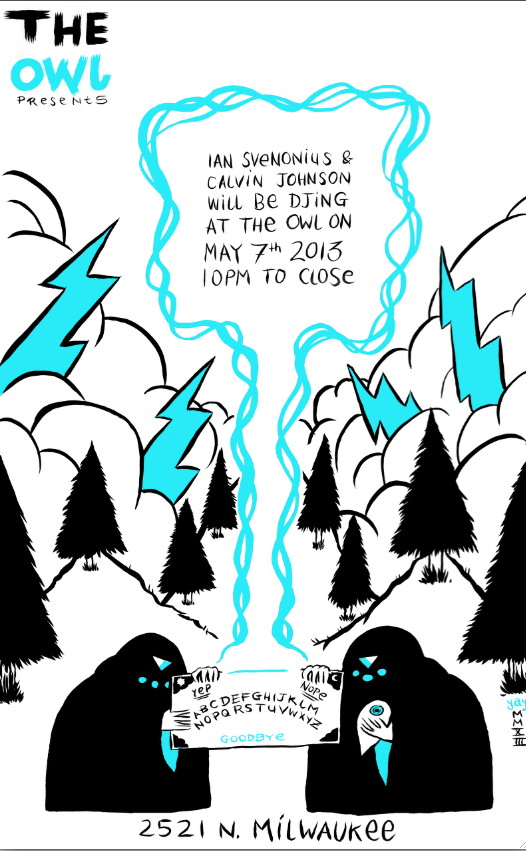
Don’t miss the official after party at The Owl where Ian and Calvin Johnson will be DJing at The Owl from 10-4. Ian will have a mixtape soundtrack for the book for sale at the after party. These will be a numbered edition of 100 tapes with silk screened covers. 2521 N. Milwaukee.
-
Hair Lit, Vol. 1 Anthology Event 3/15
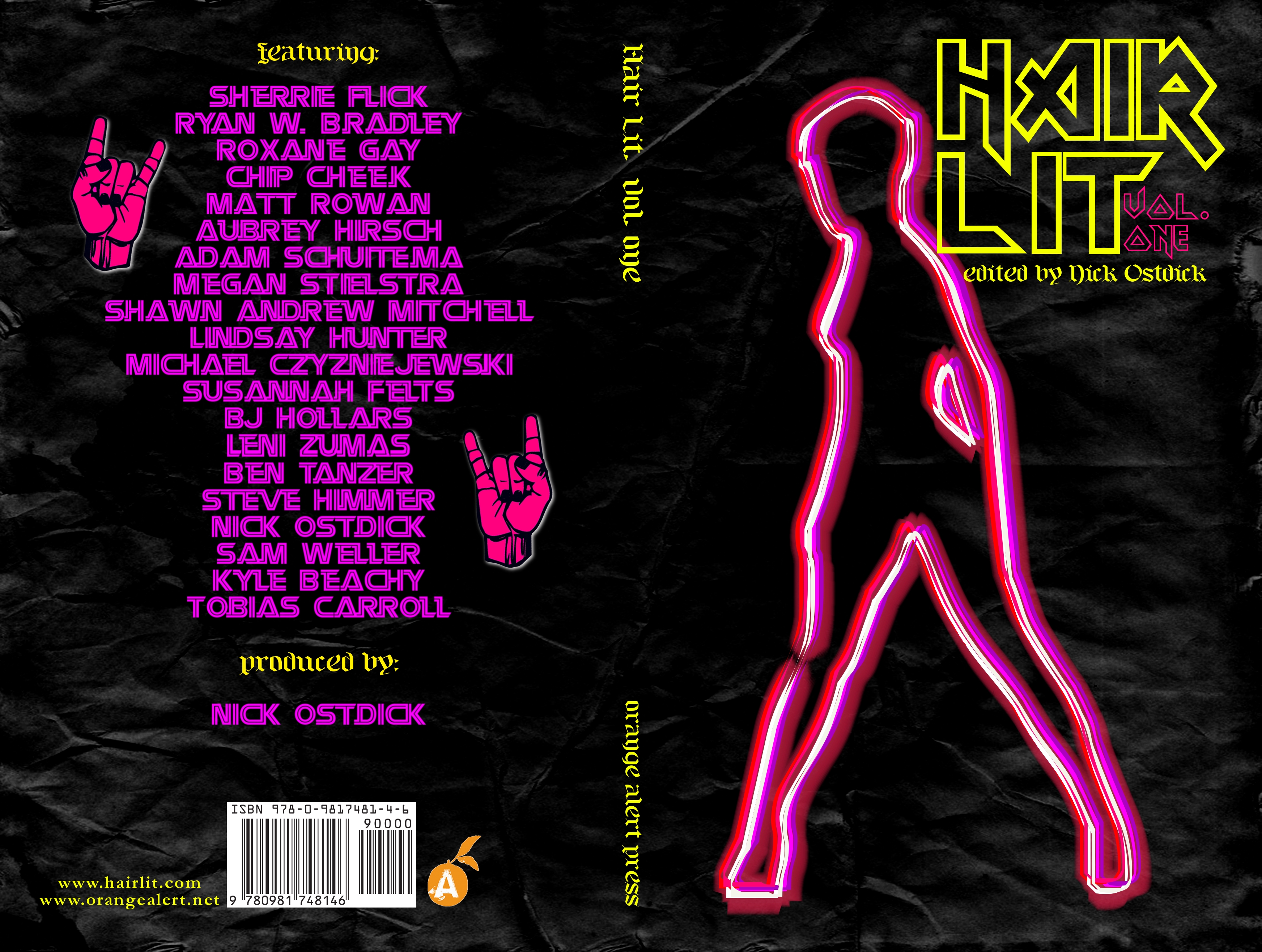
Hair Lit, Vol. 1 is an anthology of short fiction inspired by hair metal songs of the 1980’s, and it is the latest release from Chicago-based independent publisher Orange Alert Press. A collection of original short fiction based on hair metal songs of the 1980’s and 1990’s, Hair Lit, Vol. 1 is edited by Nick Ostdick and features contributions from today’s hottest purveyors of short fiction, including Sherrie Flick, Ryan W. Bradley, Roxane Gay, Chip Cheek, Matt Rowan, Aubrey Hirsch, Adam Schuitema, Megan Stielstra, Shawn Andrew Mitchell, Lindsay Hunter, Michael Czyzniejewski, Susannah Felts, BJ Hollars, Leni Zumas, Ben Tanzer, Steve Himmer, Nick Ostdick, Sam Weller, Kyle Beachy, and Tobias Carroll.
That’s right: the songs you craved from the bands you loved are paid tribute in this collection that rocks as hard as the music from which it’s inspired. These are stories of love and heartache. Stories of sex and drugs. Stories of misspent youth. Stories of tumultuous adulthood. Stories set to a killer soundtrack consisting of bands like Warrant, Poison, Twisted Sister, Judas Priest, Vixen, KISS, and more. It’s a best-of-album-in-stories that shines a spotlight on an often overlooked period of popular music from an eclectic group of young writers who honor the source material in superb fashion, big hair and all.
Readers for the evening include Hair Lit contributors: Matt Rowan (editor of Untoward Magazine), Lindsay Hunter (author Daddy’s and the forthcoming Don’t Kiss Me) and Mike Joyce (editor of The Literary Orphans)
Nick Ostdick, the anthology’s editor, is a husband, runner, and writer currently residing in Rockford, Illinois. He holds an MFA in Fiction Writing from Southern Illinois University and is the co-editor of the forthcoming anthology The Man Date: 15 Bromances (Prime Mincer, 2013). He’s the winner of the Viola Wendt Award for Fiction and has been nominated for a Pushcart Prize, and his work has appeared or is forthcoming in Annalemma Quarterly, Exit 7, The Emerson Review, Main Street Rag, Fiction Writers Review and elsewhere.
For more info: hairlit.com nickostdick.com orangealertpress.com
Friday, March 15th, 7pm – Free Event
-
“Mitch O’Connell: The World’s Best Artist” Book Signing & Slideshow With Book Designer Joseph Allen Black at 3/21
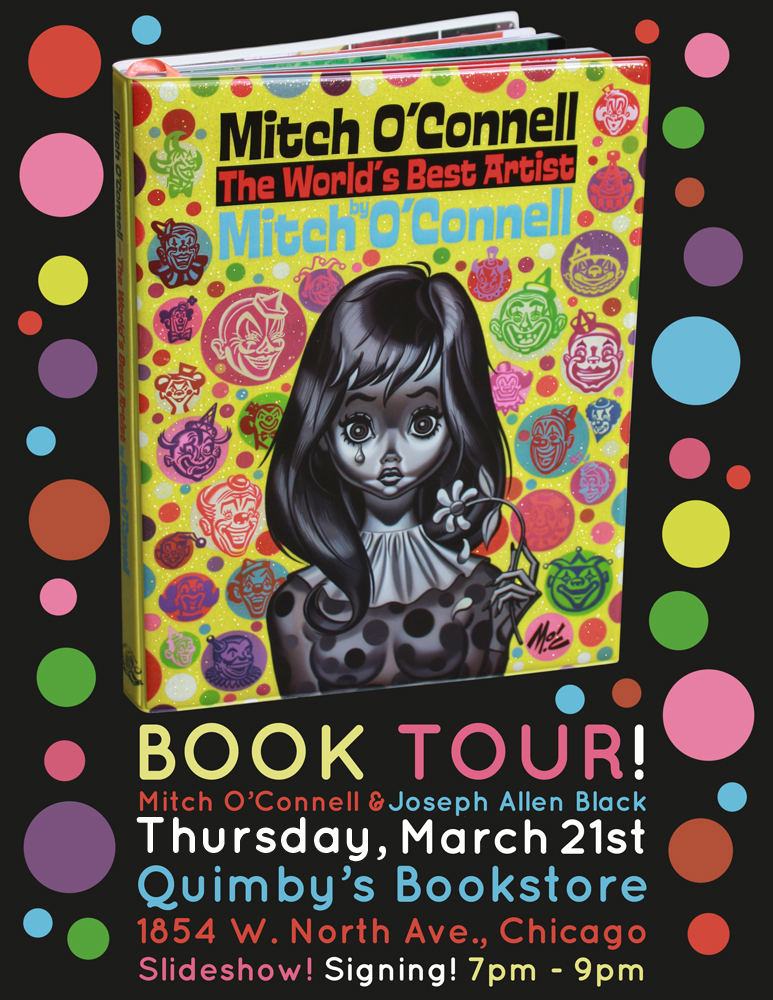
Humorous and masterful, Mitch O’Connell: the World’s Best Artist by Mitch O’Connell, (Last Gasp Publishing) is a career-spanning retrospective of work from the king of kitsch, Mitch O’Connell. This full-color, 284 page tome—resplendent with a foam-filled, vinyl, glitter-enhanced cover—collects all the good stuff (the crappy art is under lock and key) from this prolific pop artist. If you appreciate the finer things in life, such as beehives, boobs, and big-eyed kittens, you will not want to miss this book.
“I am stunned by how remarkably talented he is … I’ve been jealous of him for over 30 years!”-Mark Frauenfelder, Boing Boing
“What David Lynch might read to his kids at night! Great!” – Boston Globe
Mitch O’Connell’s work has been featured in such places as: Playboy, The New York Times, Rolling Stone, The New Yorker, GQ, Entertainment Weekly, Newsweek, and Juggs. He has made campaign art for Coke, McDonalds, KFC, Kelloggs, and more. His tattoo designs can be found on bodies belonging to people with impeccable taste the worldwide. His previous books include Mitch O’Connell Tattoos, Pwease Wuv Me, and Good Taste Gone Bad.
Mr. O’Connell will be joined by the book’s designer Jospeh Allen Black.
For more info: mitchoconnell.com lastgasp.com and jospehallenblack.com
Thursday, March 21st, 7pm – Free Event
-
Peter Sotos & Publisher Chip Smith Discuss Controversy in Publishing 3/23
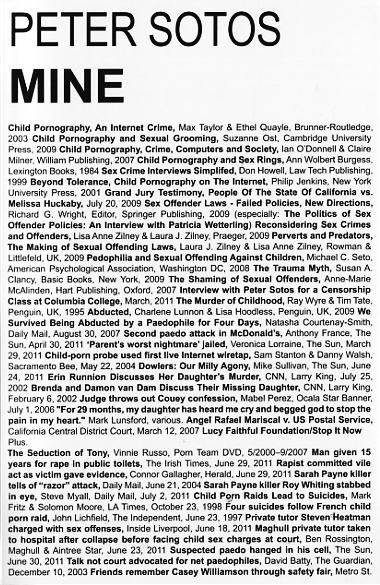
Marking the roughly simultaneous re-release of Peter Sotos’ Tool and Mine, Sotos will appear at Quimby’s Bookstore with his publisher Nine-Banded Books founder, Chip Smith, to discuss the continuing role of independent publishers in curating controversial and overlooked literature.
“Peter Sotos is one of those rare writers who can say, ‘The words I write are me,’ or at least as close as anyone can come to communicating who they are in words.” –Thomas Ligotti, author of The Conspiracy against the Human Race
“For this latter-day homo sacer, wounds are not to be healed but poked and worried until they bleed. Sotos is literature’s outcast, carrying stigma like a rat carries plague.” –Mikita Brottman, author of Thirteen Girls
“…among the most important writing being done today.”
–Dennis Cooper, author of The Marbled SwarmPeter Sotos is a Chicago-born writer whose work focuses on criminal psychology, sexual abjection, and the myriad aspects of pornography. (He was also an early member of the noise group Whitehouse.) Noted his unique literary style and his frank and insightful engagement with deeply disturbing subjects, Sotos’ writings are considered by many to stand as oblique social criticism. Sotos is the author of 11 published novels, including Index, Tick, Lordotics, Comfort and Critique, and Selfish, Little: The Annotated Lesley Ann Downey. He is also the editor of the Pure Filth, an annotated collection transcripts culled from the underground pornography of the late Jamie Gillis. Sotos’ writing has appeared in ANSWER Me!, Apocalypse Culture II, Funeral Party, and Ritual Sex.
And oh yeah, he often comes in to Quimby’s (always wearing a long coat) with records he bought around the corner at Reckless Records. One time it was a greatest hits from The Smiths, prompting us to fun of him.
For more info: ninebandedbooks.com and quimbys.com
Sat, March 23rd, 7pm – Free Event
-
Justin Maurer Reads From Seventeen Television with Cassandra Troyan and Dave Roche 2/19

In Justin Maurer’s new book Seventeen Television (Vol 1 Brooklyn), these mostly true stories ebb, flow and burn through heart breaking and illuminating moments in his life. Seven humor-filled tales delve into family crisis, dead-end jobs and international exploits. Through these lucid stories and their incendiary cast of characters, we follow him into equally dangerous and touching territory.
The work of Justin Maurer has been featured in such places as: The L.A. Record, Color Magazine, The Rumpus, Faster Times, Vice Spain, Maximumrocknroll, Razorcake and Vol 1. Brooklyn. He has been featured on podcasts and radio shows such as Life Before Wartime (KBOO), Cherry Blossom Clinic (WFMU) and Skid Row Radio. His first book, Don’t Take Your Life (Future Tense Books) received much critical acclaim. He has recorded and toured extensively with his punk bands Clorox Girls, Suspect Parts, LA Drugz and Maniac. He works and lives in Los Angeles.
Cassandra Troyan is an artist, writer, and filmmaker who is interested in getting blunted. She is the author of THRONE OF BLOOD (Solar Luxuriance 2013), and forthcoming in Fall 2013, The Things We Embody Are The Things We Destroy (Tiny Hardcore Press 2013). She curates the reading and performance series EAR EATER in Chicago, IL where she currently lives and works.
Dave Roche is the author of On Subbing and the zine About My Disappearance (among other things).
For more info:
Tues, Feb 19th, 7pm – Free Event