Your cart is currently empty!
Category: interview
-
Rob Drew Celebrates Unspooled: How the Cassette Made Music Shareable, June 22nd
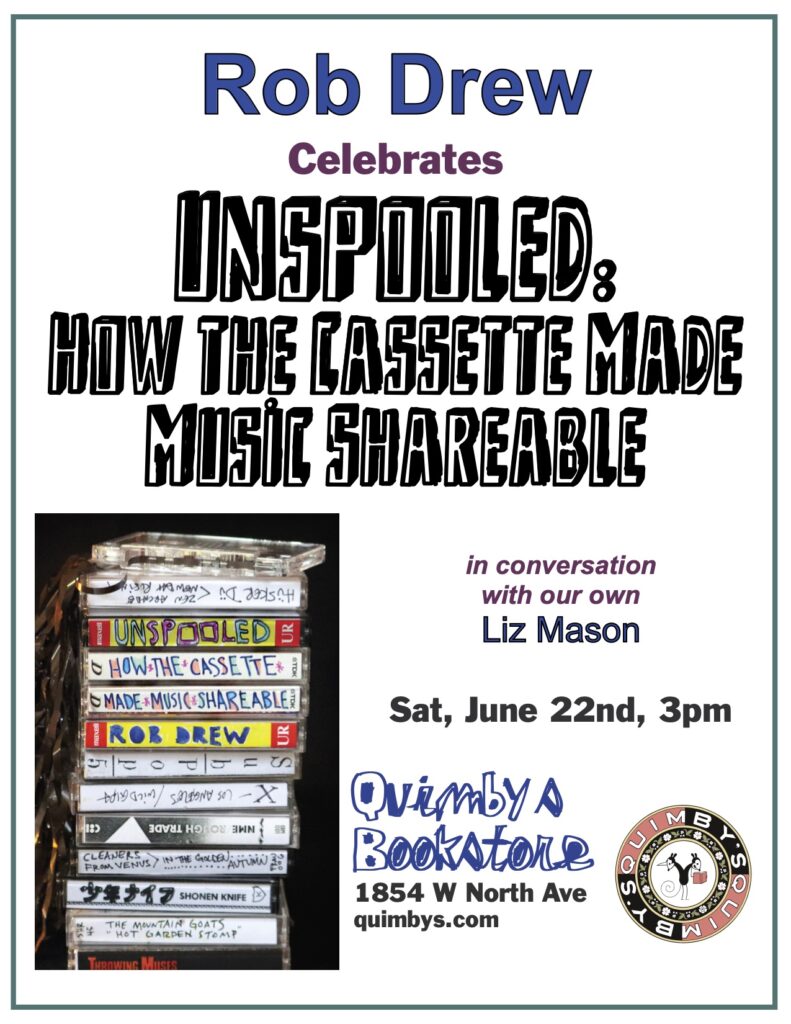
Rob Drew Celebrates
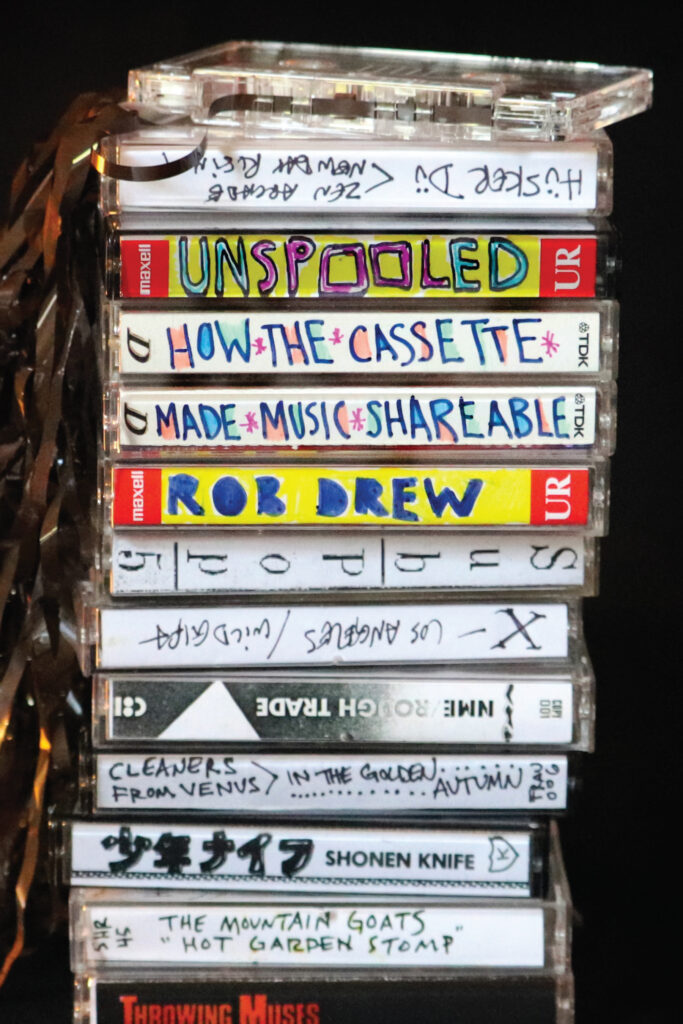
Unspooled: How the Cassette Made Music Shareable,
In Conversation with Liz Mason
at Quimby’s Bookstore
1854 W. North Ave
Saturday, June 22nd, 3pmQuimby’s welcomes Rob Drew to celebrate the release of his book Unspooled: How the Cassette Made Music Shareable on Saturday, June 22nd at 3pm, in conversation with Quimby’s manager Liz Mason.
Join us to hear Dr. Rob Drew trace the history of the cassette tape, a cheap, low-fidelity music medium that fans grew to love. Rob will discuss how cassettes upended the music industry, inspired independent musicians, and initiated rituals of music sharing through mix tapes.
Well into the new millennium, the analog cassette tape continues to claw its way back from obsolescence. New cassette labels emerge from hipster enclaves while the cassette’s likeness pops up on T-shirts, coffee mugs, belt buckles, and cell phone cases. In Unspooled, Rob Drew traces how a lowly, hissy format that began life in office dictation machines and cheap portable players came to be regarded as a token of intimate expression through music and a source of cultural capital. Drawing on sources ranging from obscure music zines to transcripts of Congressional hearings, Drew examines a moment in the early 1980s when music industry representatives argued that the cassette encouraged piracy. At the same time, 1980s indie rock culture used the cassette as a symbol to define itself as an outsider community. Indie’s love affair with the cassette culminated in the mixtape, which advanced indie’s image as a gift economy. By telling the cassette’s long and winding history, Drew demonstrates that sharing cassettes became an acceptable and meaningful mode of communication that initiated rituals of independent music recording, re-recording, and gifting.
“Offering a comprehensive history of the cassette from its origins in post-World War II taping technologies to the recent revival of the music cassette as a hipster artifact, Unspooled is the first book to give an extended account of the various ways that cassettes have transformed musical culture. This wonderfully engaging, clear, and witty book will appeal to a wide audience of music fans and critics interested in mixtapes, cassettes, and cassette culture and will become a classic in many fields.” -Will Straw, Professor of Urban Media Studies, McGill University
“Rob Drew is one of my favorite writers on music, and I wish more people knew about his work. This is the definitive cultural history of indie music’s tangled but fascinating love affair with the audiocassette.” -David Hesmondhalgh, author of Why Music Matters
“Any readers who have ever received or created a mixtape will appreciate this narrative. A solid blend of history and nostalgia about cassette tapes that’s perfect for Gen Xers.” -Tina Panik, Library Journal
“The story of the cassette tape Drew and Masters tell is compelling: how a lo-fi, accident- and deterioration-prone, and more-or-less parasitic audio technology not only achieved market dominance but captured a permanent place in the imaginations and practices of music-makers, labels, distributors, and fans the world over. Unspooled and High Bias show readers that the peculiar technology of the cassette tape exemplifies the inherent contradictions of popular music perhaps better than any other medium.” — David Pike, Popmatters
“Divided into six sharp chapters, Unspooled walks readers through the rich history of music nerds who used cassettes in ever-evolving ways. By following the chronology, Drew provides a detailed exploration of the cassette in terms of format, medium, and artifact.” — Adam P. Newton, Treble Zine (Read the full review here.)
Rob Drew is Professor of Communication at Saginaw Valley State University and author of Karaoke Nights: An Ethnographic Rhapsody. Follow him at @slobster48602
Liz Mason is the manager of Quimby’s Bookstore, a zine publisher, a mix tape aficionado and a karaoke enthusiast. Follow her at @caboosezine
Want the Facebook event invite for this? Here ya go!
Watch Rob on the “Cassette Books Mixtape” panel with Marc Masters (High Bias: The Distorted History of the Cassette Tape), Jerry Kranitz (Cassette Culture: Homemade Music and the Creative Spirit in the Pre-Internet Age), moderated by Tom McCourt.
-
Quimby's Offsite: Hit Girls: Women of Punk in the USA, 1975-1983, Chicago Book Party at GMan Tavern, April 27th
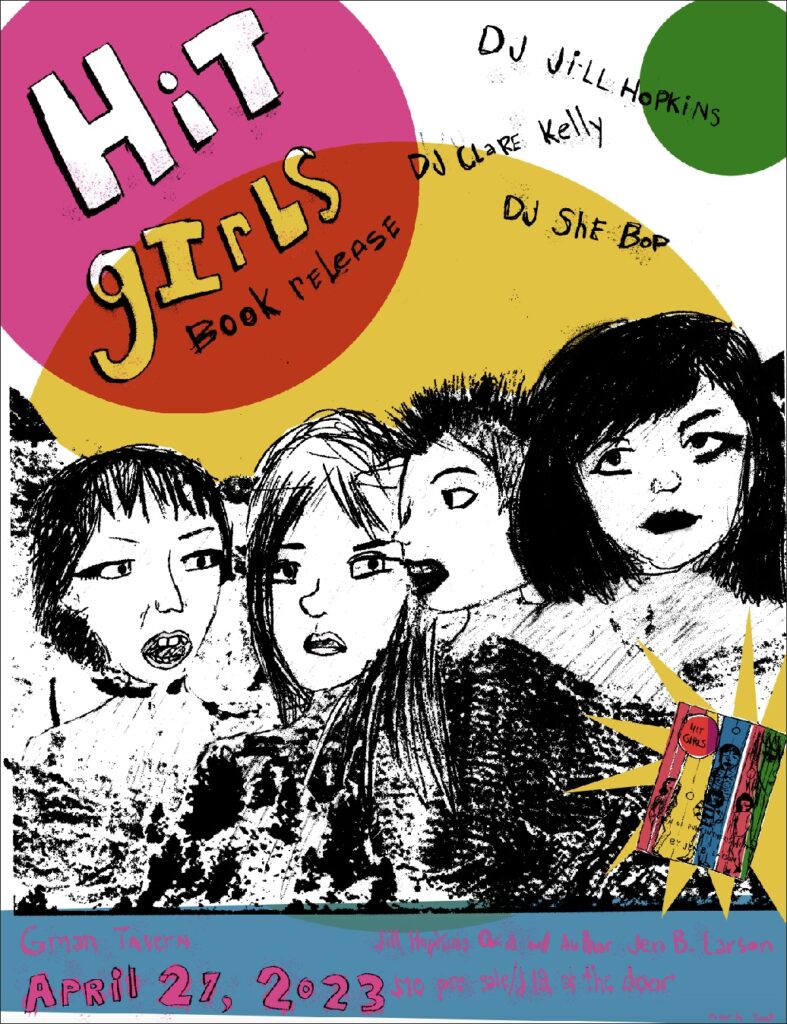
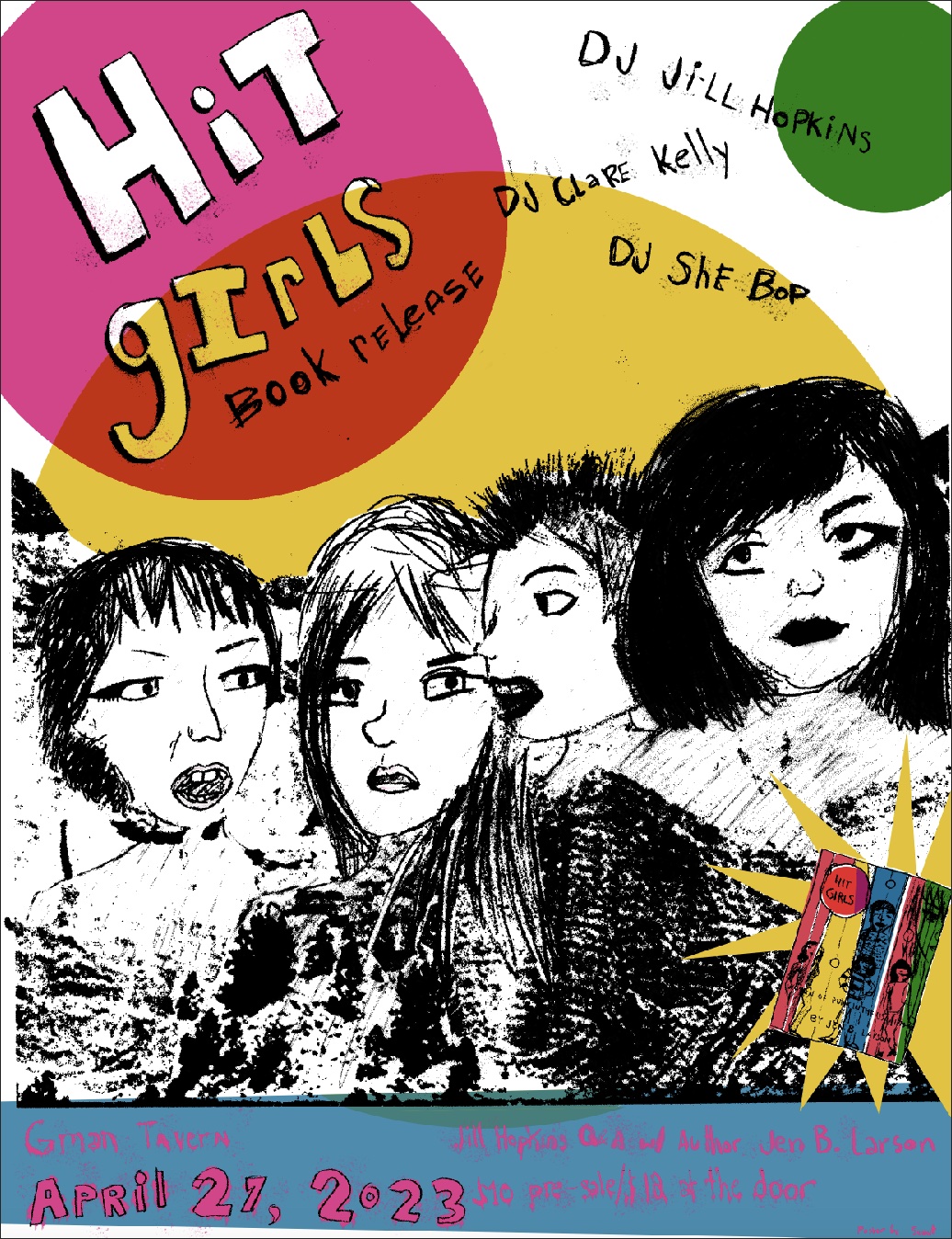
Join us at the GMan tavern on while we sell books for a very special Chicago Book Party!
Deep Eddy Vodka welcomes
Hit Girls: Women of Punk in the USA, 1975-1983
Author Reading with Jen B. Larson * Q&A hosted by WBEZ’s Jill Hopkins
Thursday, April 27th
Doors: 7pm / Show: 7:30pm
$10 Adv. / $12 Door / 21+
Jen Lemasters (aka She Bop), Clare Kelly, and Jill Hopkins DJ
at GMan Tavern, 3740 North Clark Street Chicago, IL.
(Note: this event is not at Quimby’s.)Click this link to buy tickets at etix.com.
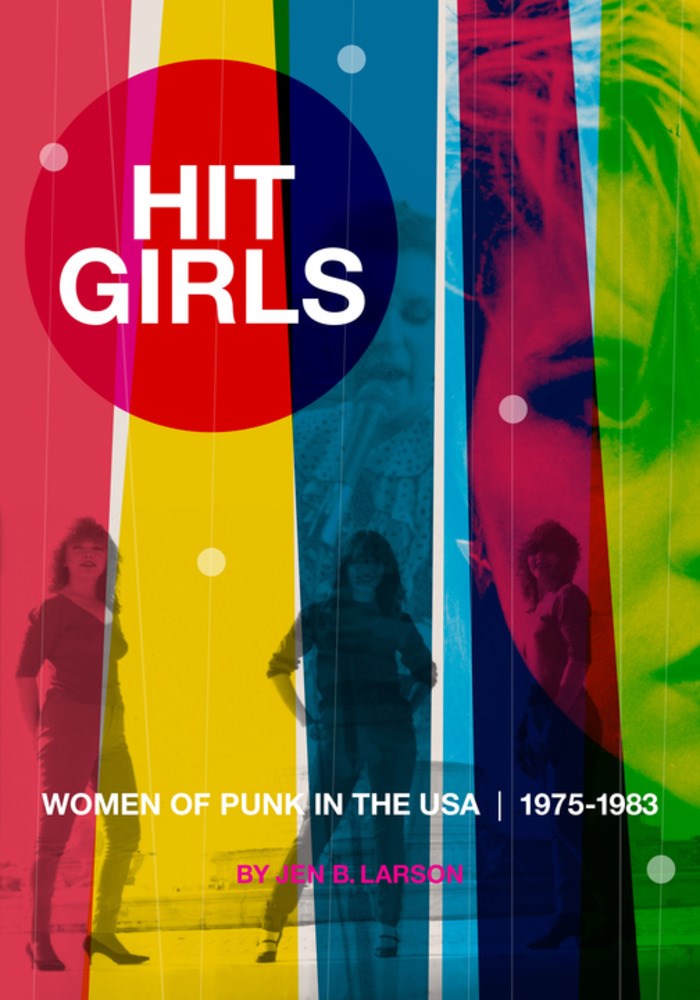
About Hit Girls (published by Feral House):
Think punk was only a boys club? Read about the women who were the punk revolution!
Women have been kicking against the pricks of music patriarchy since Sister Rosetta Tharpe first played the guitar riffs that built rock-n-roll. The explosion of punk sent shockwaves of revolution to every girl who dreamed of being on stage. Punk godmothers Suzy Quatro, The Runaways, Patti Smith, Poison Ivy, Tina Weymouth, Debbie Harry, The Go-Gos, and Fanny’s Millington sisters provided the template for thousands of girls and women throughout the United States to write and record their songs.
Hit Girls is the story local and regional bands whose legacy would be otherwise lost. Despite the modern narrative labeled women anomalies in rock music, the truth is: women played important roles in punk and its related genres in every city, in every scene, all over the United States. The women and bands profiled by Jen B. share their experiences of sexism and racism as well as their joy and successes from their days on stage as they changed what it meant to be in a band. These pioneering women were more than novelty acts or pretty faces–they were fully contributing members and leaders of mixed-gender and all-female bands long before the call for “girls to the front.”
The women of Hit Girls are now rightfully exalted to cult status where their collective achievement is recognized and inspiring to new generations of women rockers. Included are interviews with: Texacala Jones, Stoney Rivera, Mish Bondaj, Alice Bag, Nikki Corvette, Penelope Houston, and many more formidable and infamous women who made their voices heard over the screaming guitars.
Hit Girls includes over 100 rare and never-before seen images. Author Jen B. includes a comprehensive playlist of all the artists. Foreword by punk journalist, Ginger Coyote.
About the author: Jen B. Larson is a writer, musician, and public art schoolteacher living in Chicago. She holds a B.A. in English literature and creative writing as well as an M.Ed. in special education. Her bands, Swimsuit Addition, beastii, and Jen and the Dots, have performed and recorded extensively over the last decade. Visit Jen on the web at instagram.com/conspiracyofwomen.
Wanna buy the book in advance? Come in to the store or get it off our website here.
-
Steven Krakow, author of My Kind of Sound: The Secret History of Chicago Music, in conversation with the Reader’s Philip Montoro on 2/18
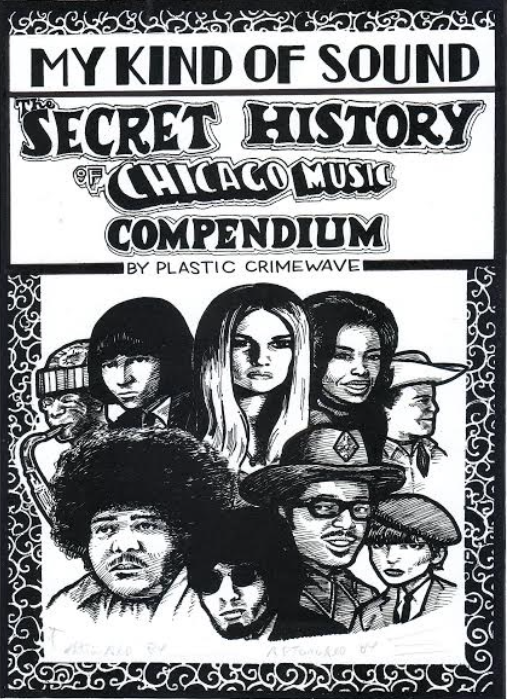
Steven Krakow’s My Kind of Sound (Curbside Splendor) compiles more than a decade worth of “The Secret History of Chicago Music,” the illustrated column by Steve Krakow (“Plastic Crimewave”) that has been printed bi-weekly in the Chicago Reader since 2005. There is much to discover in these stories; amidst the slighted fame, botched contracts, overdoses, and break-ups, Krakow spotlights the glory that exists in making music.
Some of these musicians made considerable contributions to Chicago’s music culture, rivaling those of the legends we all know and collect. And some of them didn’t, but Krakow insists that you know about them. Each of the more than 200 columns included in My Kind of Sound were painstakingly constructed by Krakow in his signature scissor-and-glue process, the same he employs in his long-running psychedelic zine, Galactic Zoo Dossier. Charmed though his process may be, Krakow’s gigantic love for music and the people who make it is serious and staggering and the resulting collection is as fun as it is important.
“[The Secret History of Chicago Music] is an education even for us know-it-all music obsessives, and are the only comics that have sent me directly to the record store to dig in the bins for dusty gems.”
—Jessica Hopper, Pitchfork, author of The First Collection of Criticism by a Living Female Rock CriticFacebook invite for this event: https://www.facebook.com/events/106144166435422/
For more info, email Catherine Eves: catherine(at)curbsidesplendor(dot)com
-
Q&A with Tonight's Reader David Moscovich

David Moscovich David Moscovich, author of You Are Making Very Important Bathtime, is no stranger to cross-country jaunts. The New York resident will be journeying here to Quimby’s for a reading with fellow writer Eckard Gerdes tonight. Nicki Yowell, Quimby’s Outreach and Communications Coordinator, caught up with David to chat about clumsy Japanese translations, the perils of teaching and the many iterations of his performances.
Quimby’s: You’ve resided in quite a few places during your life: Portland, New York, Boston, Japan. Would you say your personal well-rounded sense of place factors strongly into your work?
David Moscovich: My sense of place is probably more lopsided because of my personal geography — but being a Nebraska boy at root keeps me humble enough. Growing up in my own personal iron curtain as a Romanian-American in Nebraska gave me a sense of aloneness that didn’t disappear until I visited the old country as an adult. How does that translate into my work? I think it keeps experiences relative, and my attempt with Bathtime is to fuel misunderstandings between characters with even greater misunderstandings, to pose the assumptions of American and Japanese cultures in comical juxtaposition with each other. I try to expose the narrator’s biases and preconceptions in Bathtime by allowing him to gaff and to faux pas his way through most situations. In a sense, I tried to create a character who has committed a spiritual crime, a kind of culture-cide, but does not have the conscience to realize it. It torments him but not in the way a Raskolnikov is tormented.
Q: Flash fiction is a literary medium that seems to fit well with our times. Short, punchy, quick to get your attention. What draws you to shorter narratives? Are they more approachable in our temporally fractured culture?
DM: The way the story tells the story has to be more immediate in short fiction. I want to say more with less, and I also revise obsessively. It’s not that I am always drawn to the short form, but often I’ve cut back more than fifty percent of the words. You Are Make Very Important Bathtime is a complete rewrite of a much longer novel that I threw out to rework the voice. I wanted it to be about the voice. I also think of short fiction like punk rock. Put together fifty fast-paced songs and there is a concentrated performance that tells a longer story.
Q: The title of your latest book, You Are Make Very Important Bathtime, reminds me of a dubiously named website, Engrish.com. Translating Japanese to English can be a tenuous, problematic proposition, indeed. How does the central problem of language factor into the story?
DM: You Are Make Very Important Bathtime plays with the notion of weird, broken, unconventional and/or unaccepted grammar as a cause for celebration. Usually without thinking we accept grammar as a set of patterns that are “correct” in any given language without acknowledging that “correct” grammar might be viewed as merely another aesthetic.
Throughout the work is the comma splice, which came from a desire to intentionally circumvent the rules of punctuation and give the sense of reading each story in one long breath. The Japanese language also allows for females to refer to themselves by name. A character, Kimiko, says to the narrator: Kimiko loves okonomiyaki. These types of peculiarities fascinate me, like the fact that it’s possible to hold an entire conversation in Japanese without the use of a subject.
Language teachers might berate a student for collocational fumbles or syntactical mishaps but language itself loves errors and to me it sounds like poetry. Japanese is a very flexible tongue. Switch around verbs and nouns and leave out subjects, still we are understood. Languages are transforming, living beings, the long tentacles of cultures they are attached to. My attempt is to embrace all of it, to fully love the flexible grammar out there.
In one of the stories, a certain beer menu reads, “Please Choose the Drunk.” It’s incredible how much impact a single letter can have. And that is part of the book, this enormous potential that lies within the playing and shifting of letters.
Q: How has teaching shaped your point of view of writing? Do you ever picture your students as your audience or are you their audience?
DM: The goal for me is to marry writing and teaching by channelling them in a state of urgent transmission. Writing happens from a necessity of expression, as Rilke would have it. The delineation between teaching and the performance behind the writing disappears. That is the ideal — to share completely and selflessly what has worked for me as a writer, and equally so, what has not worked.
Q: Much of your work has a performance or performed component. You’ve done radio broadcasts and musical collaborations in addition to your live readings. Do you consider these performances to be separate and complete or a necessary companion to the written work you make?
DM: I like to think they compliment each other but ideally each stand alone. They are also different mediums. If a person prefers reading without the social aspect necessary for performance they can read instead. What I’m trying to do with the live performance is to offer something from my work that a reader cannot get just holding the book. But even within reading a written story to oneself there are so many possibilities. Any book could be read in a non-linear fashion as well as the traditional way from the first story to the last. You Are Make Very Important Bathtime was designed as a book to be read in any and every order whatsoever. The sequence offered in the book as published could be thought of as a “serving suggestion.” The reader sets the table.