Your cart is currently empty!
Category: politics/revolution
-
Hear ye Hear ye! Opportunities For You
Here’s some oppportunities to submit your work or ideas that we thought you might appreciate:
 For Version 11 Festival and Related Activity:
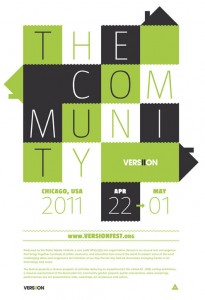
Version 11: The Community
April 22 to May 1, 2011
Chicago • USAA Call For Proposals.
Deadline March 26, 2011“These years of recession, insolvency, uncertainty, and calamity have affected us in ways we couldn’tve imagined before. The debt crisis, atomized and divisive political culture, a lethargic economy that sees almost one of out of eight people out of work, and attacks on our collective social welfare can only mean one thing: It’s gonna get worse before it gets better.
But there is hope. In the dusty corners of the world, individuals, friends, collaborators, and affinity groups are cementing bonds and creating methods for survival in this so-called “marketplace” where we all work, play, and inhabit. These artists, art workers, writers, activists, and organizers (also their enthusiasts, supporters, and fans) still believe in growing the gardens of our social and cultural ecology, despite the hardships we collectively endure.
Version 11 is a celebration of the Chicago communities — projects, spaces, groups, individuals — creating their own strategies for participatory economies, co-prosperity, and the pursuit of genuine happiness. Version will demonstrate the possible, celebrate the impossible, and showcase the ingenuity, spirit and passion that create The Community we aspire to take part in together. This is an invitation to share your community, your goals, your dreams for a better Community of the Future. It’s all we have left.
Produced by the Public Media Institute, a non profit 501(c)(3) arts organization, Version is an annual arts convergence that brings together hundreds of artists, cultural workers, and educators from around the world to present some of the most challenging ideas and progressive art initiatives of our day. The ten day festival showcases emerging trends in art, technology and music.
The festival presents a diverse program of activities featuring an exposition/art fair called The MDW Fair, guest curated exhibitions, a massive reenactment of the Haymarket Square riot, community garden projects, public interventions, video screenings, performances, live art, presentations, talks, workshops, art rendezvous and action.
Email Proposals with Subject Line: Version 11 to edmarlumpen (at) gmail.com
Please send us a 100-300 word description of your proposal.
We are accepting proposals for these platforms:
Free University (FREE U)
Each year Version features workshops, presentations, demonstrations, talks, lectures and classes within the framework of the Free University platform. Ideas for provocations and projects as well as instructional guides, lecture and class ideas are welcome.Performance/ Interventions/ Mobile Projects
Performance art in site specific locations, picnics, tours, public interventions, asphalt canoeing, anarchist marching bands, creative disturbances in public space are important components of the festival. Initiatvies by space hijackers and performance artists of all stripes welcome.
Call for TEXTS Proximity 009
This year Proximity magazine will be releasing it’s Community themed issue covering the Chicago art worlds. It’s a revisiting of issues addressed in Issue #1. Send a proposal very very soon.The MDW Fair: visual arts landing in Chicago
CHICAGO: threewalls, Roots and Culture and Public Media Institute announce The MDW Fair, a gathering of alternative art initiatives, spaces, galleries and artist groups from the Chicago metropolitan area. Held April 22-23, 2011 at The Iron Studios, 3636 S. Iron Street, The MDW Fair will demonstrate the diversity, strength and vision of the people/places making it happen in the art ecology of our region.The fair features for-profit, 501(c)3, and commercial and unincorporated galleries, independent curatorial projects and publishers and media groups in over 25,000 square feet of exhibition space that includes a 10,000 square foot sculpture garden with work by local artists. The MDW Fair is a manifestation of the collective spirit behind the region’s most innovative visual cultural organizers, focusing on the breadth of work done here by artists and arts-facilitators alike. Participants include: threewalls, Roots and Culture, Reuben Kincaid, ebersmoore, Antenna, OxBow, The Suburban, ACRE, Iceberg Projects, The Post Family and more.
The MDW Fair is currently accepting proposals from independent curators due April 1st. Please send a project description and up to 10 images of proposed work to mdwfair@gmail(dot)com. “
 From The Wunderkabinet:
“We’ve played our exhibitions close to the heart of late and forgone on the open calls, but the upcoming transformation of The Wunderkabinet into No. 3/The Reading Raum has us wanting to reach out to writers and zinesters around the globe. We’ll be splitting the kabinet into two components: ‘for sale’ & ‘read-only’. This means that if you’re more into the collecting than the making, you could lend or donate zines to the exhibition. Of course, if you’re a maker of zines, books, and related ephemera, we want to hear from you, too! The deadline to get in touch with us is March 25 – please do so if you have any questions. Submission guidelines can be found HERE! No. 3 will open in mid-May and run for the summer.”
Thanks to Edmar and Becky for the info!
-
Borders Is bankrupt. So let us order the book you want.
It’s true. With Borders crossing over into the border of being Border less we can still whatever book you want (if it’s in print and the distributors we go through have it).
Like what, for example? Like this for example…
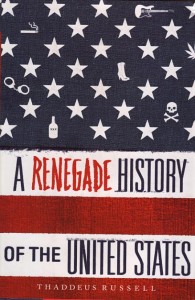
The Renegade History of the United States
by Thaddeus Russell
This people’s history of ‘merican scoundrels, nogoodniks, misfits and criminals. This is the balls-to-the-wall version of the U.S. of A. you really do wish you learned about in school. A nice hardcover for only $27.00.
-
Call for Proposals: AREA issue #11 – im/migration

AREA Chicago is dedicated to gathering and sharing information and histories about local social movements, political and cultural organizations. They do a biannual mag and lots of events. They’re accepting proposals for their upcoming issue. Here’s their announcement:
Chicago is a city shaped by movement and trade. First inhabited by indigenous peoples, the city was built through land speculation at the intersection of major waterways, and expanded as the intersection of railroads and highways. It became the destination for successive waves of new arrivals seeking opportunity: from those escaping the Jim Crow South and European fascism during the industrial era, to post-industrial rustbelt refugees and, most recently, those displaced from a structurally adjusted global south in the era of free trade. Today’s corporate towers tout Chicago’s preeminence as a hub for the non-stop flow of global capital. Mainstream media often couch these economic, demographic and spatial shifts within a partial and simplistic narrative of “progress”. AREA Issue #11 is calling for a range of contributions to support a more robust and nuanced discussion of human movement, and its impact on the political and cultural life of our city.
The distinction between migration and immigration can be viewed and discussed via the concept of the nation-state. In recent decades, as globalization opened borders for the movement of goods, natural resources and currency, a call for national security is increasingly used to justify the policing of human movement. US international policy has resulted in the forced dislocation of peoples around the world, while the fear of losing jobs and social benefits to immigrants is used to criminalize migrant labor forces in the US. Meanwhile, domestic policies increasingly reinforce inequalities along race and class lines. These disparities take physical form in our cities and can be seen by mapping the distribution of social services, wealth and resources, and access to arts and culture. In our city political forces draw imaginary lines that have real, tangible consequences for those who must navigate them.
How have internal migrations, such as the African American Great Migration and white flight, shaped the physical and psychological space of the city? How are race politics woven into the visible and invisible borders that crisscross the urban landscape? What are the forces driving displacement and gentrification, and how are they being resisted? Whose mobility is deemed “legitimate” and whose is considered a “trespass”? How is access created and redefined by im/migrants and people disabilities? Who is intentionally immobilized and by what forces? How does human movement impact the natural environment—from animal migration patterns to invasive species?
As immigrants arrive in Chicago from around the globe, what do they carry with them and what is left behind? How are language, food and music preserved as transmitters of culture, and how are they transformed? What is shared in the experience of immigrants from different countries of origin and what is particular? How does the immigrant experience differ according to age and place in life? How does identity shift in relation to where one stands at any given moment and to whom one speaks? How does media focus on Latina@ immigrants affect the discourse around immigration in the US? How does immigration reform reinforce the legitimacy of borders and the increased militarization of society?
While issues central to the theme of im/migrations are among the most talked about political issues in the country today, it seems that remarkably little is actually being said. In Im/migrations we invite contributors to depart from the mainstream discourse, to traverse the blurry line between personal and political experiences of movement.
We hope the issue will be an opportunity to explore the diverse politics of the individuals and organizations working for the rights of the undocumented. We invite contributors to challenge existing dialogues about immigration reform and to think of AREA as a space to experiment with new possibilities for language and action. We hope it will be a space to explore how migration and immigration intersect with other movements, such as those for environmental justice, gender justice, economic justice, and more. We also hope the issue will serve as a movement-building tool for those working to carve out a space in the city and defend the right to stay.
If you have something to say about these issues, we invite you to contribute! Your contributions can take many forms. We are interested in brief descriptions of the work you or your organization are doing, analysis and commentary, interviews, mapping projects, photography and other visual expressions, events, performances and more. If you have an idea, but are unsure how it might fit into im/migrations we´ll be happy to discuss the possibilities with you.
Proposals are due February 1st. Scheduled for release in May 2011.
Direct proposals, comments and questions to: immigration@AREAchicago.org
-
Modern-Day Griot Arthur Flowers Shares His Graphic Novel on Dr. MLK Jr. 2/12
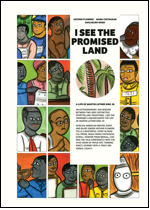 In celebration of Black History Month, Arthur Flowers celebrates I See the Promised Land: A Life of Martin Luther King, Jr., a singular take on the graphic novel genre, an extraordinary jam session between two very distinct storytelling traditions. Flowers tells a masterful story in musical prose. Artist Manu Chitrakar, a scroll-painter from Bengal, India, carries the tale confidently into the vivid idiom of Patua art, turning King’s journey into a truly universal legacy. replete with destiny, fate and the human condition, I See the Promised Land traverses the milestones of King’s short life, his ministry and journey, in a dramatic collaboration.
“Both evocative and factually rich…a standout both as a distinctive graphic narrative that combines two world storytelling traditions and as an examination of King’s life and its enduring legacy across the globe.” – Booklist Starred Review
Arthur Flowers, a remarkable performance artist and oral historian, originally hails from Memphis. He is an associate professor of English at Syracuse University. Arthur is a captivating presence, memorizing his text, singing from the story in a free-form jive style and accompanying himself with a small African drum. He performs with select pieces of the original Patua scroll artwork. Arthur is also the author of Another Good Loving Blues and De Mojo Blues.
Saturday, February 12, 7pm
-
Canada’s Illegal Ad Vigilante Rami Tabello With Anne Elizabeth Moore at Quimby's 11/12
“We fight illegal advertising using the rule of law,” Rami Tabello says when asked to describe the Toronto organization he founded to fight criminal billboards, Illegal Signs. It’s funded through donations and Tabello’s gambling take—a crazy support system for a group that spends a lot of time scrutinizing city bylaws and calling in complaints to the proper authorities. Tabello’s been called both “a fearless advocate for public space” and “annoying” by Toronto city residents and elected officials. He’ll present his work fighting—and beating—corporate criminals at Quimby’s in Chicago, a city with a massive illegal advertising problem of its own.
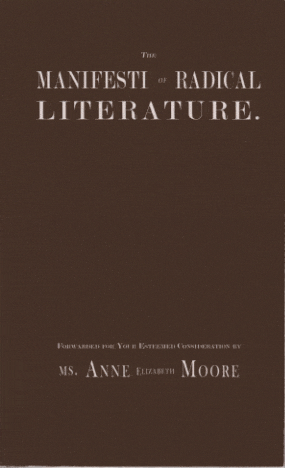
Tabello is presented by Chicago author Anne Elizabeth Moore on the occasion of the re-release of the underground hit The Manifesti of Radical Literature (MRL). Out of print for over a year, MRL is an anarchist style guide for cultural producers, with chapters on such foundational political acts as throwing away one’s dictionary, creating one’s own system of punctuation, and refusing to abide by the language imposed upon us by corporate entities. Also, it is funny and of a pleasing form and light heft, perfect for spiriting away in one’s back pocket for an evening of street stenciling or shopdropping. The expanded second edition, features a new Introduction and Afterword and improved jokes. Moore’s Unmarketable received favorable reviews in Forbes, the LA Times, Advertising Age, and the Guardian, and was called “an anti-corporate manifesto with a difference” by Mother Jones and “sharp and valuable muckraking” by Time Out New York.
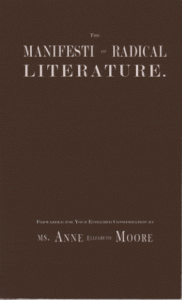
Come hear about the work of Illegal Signs, pick up a copy of MRL, and meet Tabello and Moore at 7 p.m. on Friday, November 12.
For more info:
-
Josh MacPhee Reads From Celebrate People’s History 11/11
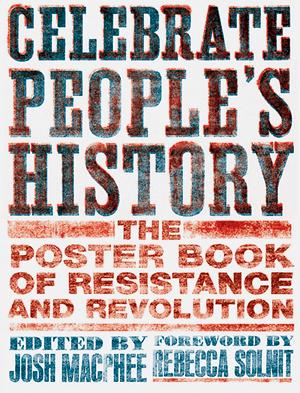
Since 1998, Josh MacPhee has commissioned and produced over one hundred posters by over eighty artists that pay tribute to revolution, racial justice, women’s rights, queer liberation, labor struggles, and creative activism and organizing. Celebrate People’s History! presents these essential moments—acts of resistance and great events in an often hidden history of human and civil rights struggles—as a visual tour through decades and across continents, from the perspective of some of the most interesting and socially engaged artists working today.
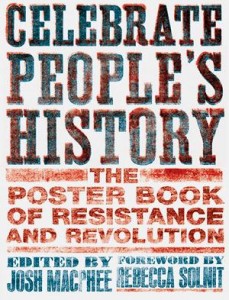
Josh MacPhee, artist and activist, is the founder of the Justseeds Artists’ Cooperative, an organization that promotes radical art forms. He is the author of Stencil Pirates: A Global Study of the Street Stencil (2004) and co-edited Realizing the Impossible: Art Against Authority (2007) and Reproduce and Revolt (2008). MacPhee is also the curator of the printmaking exhibition Paper Politics, which has been on tour in the United States since 2004.
Featured Artists in the book who will be at the event, the list is growing!:
John Jennings
Marc Nelson
Damon Locks is a visual artist and a musician here in Chicago. He performs in both The Eternals and The Exploding Star Orchestra. Always up for a good conversation, he was happy to participate in the Celebrate Peoples History book event at Quimby’s.
André Pérez, Founder of the Transgender Oral History Project, developer of educational materials about trans issues, and organizer with GenderQueer Chicago.
For more info: justseeds.org